

A colleague came back from Rustikon — a Rust developer conference — and shared a photo of a whiteboard exercise. There was a line drawn. On the left: “Fully Manual / By Hand.” On the right: “Everything Is Generated.”
The room was asked to place a dot where they actually are in their day-to-day coding. The dots clustered around the 25% mark from the left. Actually, the 25% might be a charitable interpretation. Take a look at it yourself.
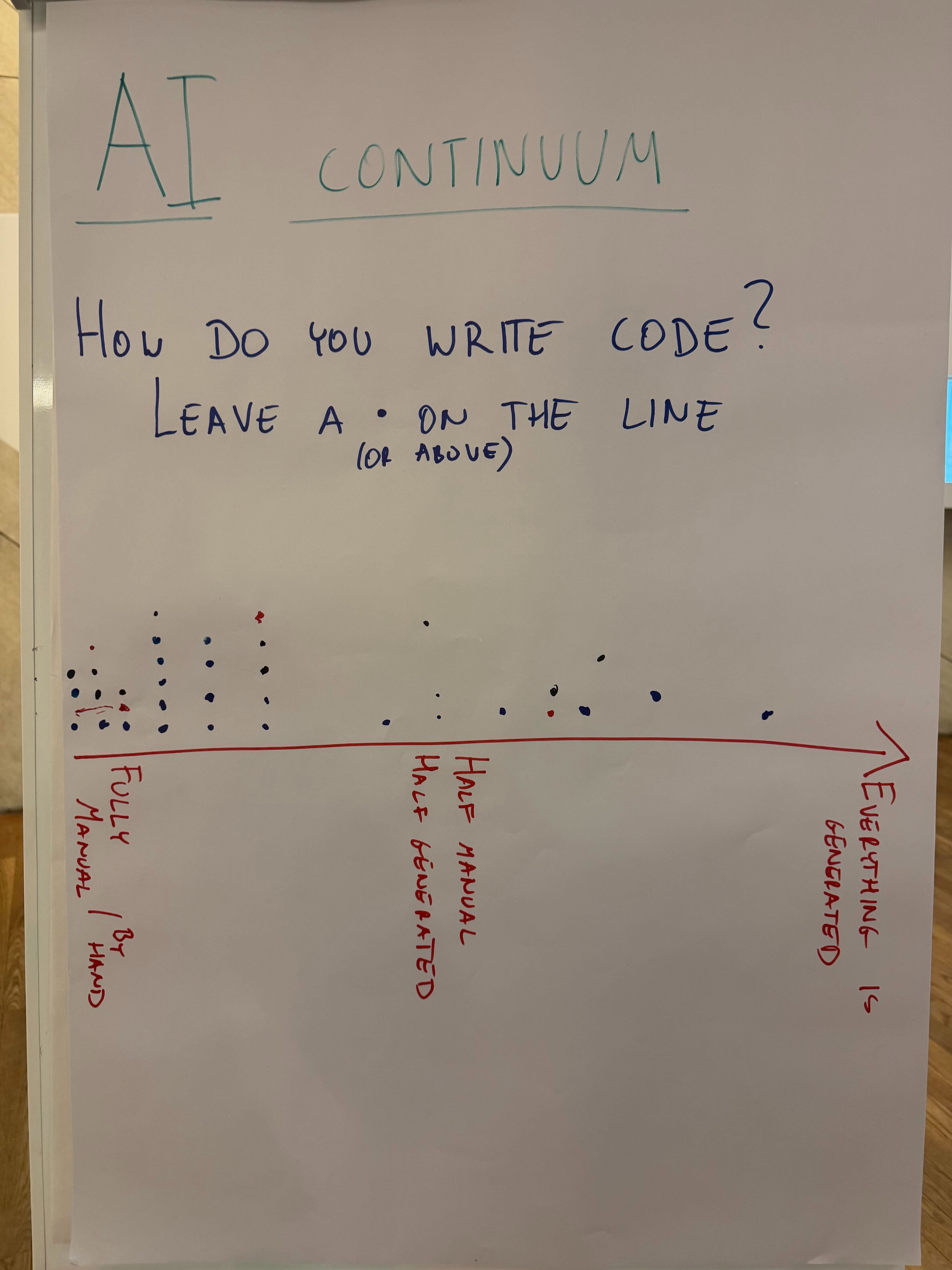
This is a room full of software engineers. People who write code for a living. And when asked honestly where they stand on the AI continuum, the majority of answers were: still mostly doing it by hand. Truth be told, my suspicion is that the Rust community might be a little more biased toward organic coding — I’ll give you that.
Even so, that photo has been stuck in my head for days now, because it captures something the industry conversation keeps getting wrong.
In March 2025, Dario Amodei told the Council on Foreign Relations that AI would be writing 90% of code within three-to-six months. Essentially all of it within a year. Obviously, the internet did what the internet does — half the people called him delusional, the other half declared software engineering dead. And naturally, the further detached they are from software engineering, the louder they get.
So here we are, a year later. And the conclusion is… mixed.
On one hand, John Crickett ran his own informal survey and found that maybe 5% of developers are heavy AI users. Around 20% use agents, mostly for tests. Many are still on autocomplete or nothing at all. That maps almost perfectly onto the Rustikon whiteboard.
On the other hand, Linear reports that coding agents now operate in 75% of enterprise workspaces, with 25% of issues handled by agents. Not a rounding error anymore — more of a structural adoption.
Here is a funny thing, though — both of these are true at the same time, and that’s the part most commentary misses.
I can clearly see this firsthand. At VirtusLab, I work with some great, capable engineers who essentially don’t write any code by hand at all anymore. They direct AI, review its output, and focus on architecture and coordination. The same is true across many companies I talk with. At The-5 — a community of entrepreneurs founded by Tomasz Karwatka — we have a group exchanging AI practices. For many, the vibe is close to 100% automation. Move anywhere near Silicon Valley startups, and it's even more so.
And yet. None of these people has stopped doing software engineering. (Though it’s worth pointing out — some of the people making the boldest claims about its death never actually started in the first place.)
That’s the distinction most people miss when they quote Dario. “AI will write all the code” is not the same as “AI will do all the software-engineering.” These are completely different claims. The gap between them is enormous.
AI today is genuinely capable of typing the code. Give it a well-scoped task — a function, a test, a migration, or even a relatively well-defined feature — and it will produce working output faster than any human. That part of the prediction is largely correct, even if adoption is uneven.
However, leave it unsupervised, without any guardrails and engineering discipline, and over time, the castle in the sand starts to crumble.
This is already visible. The code that is being generated is already straining the system, and the quality is going down. Rob Zuber at CircleCI published data showing that PR sizes increase by more than 150% when teams adopt AI coding tools. Across 28 million workflows, main branch success rates fell to 70.8% this year — the lowest in five years. The industry has become very good at producing change and strikingly bad at absorbing it.
The bottom line is: software engineering isn’t about code generation. It’s figuring out what to build. It’s understanding constraints that live in people’s heads, not in the codebase. It’s navigating organizational politics, legacy systems, and tradeoffs that don’t show up in any spec. It’s directing the architecture. This might be many years away. Or it might be tomorrow. No one knows. It is clearly not here today.
The best evidence that writing code and engineering software are different things is the current tech job market. The number of software engineering openings in the US has been growing since the bottom of the dip in early 2025.
And last but not least: Anthropic — the company behind arguably the most capable AI coding tool available — is hiring over 100 software engineers. Boris Cherny, the creator of Claude Code, was asked why and that was his answer:

The company closest to making software engineers obsolete is hiring them as fast as it can. Because even when AI writes every line, someone still has to engineer the software.
Say what you want. Dario might have been wrong about AI writing all the code by now. But he was pretty much spot on about AI being able to write all the code. This does not change the fact that engineering is still needed. And it’s not going anywhere.
A friend recently recommended I re-read Neuromancer. I guess it’s fair then to close this with:
“The future is already here – it's just not evenly distributed.”