

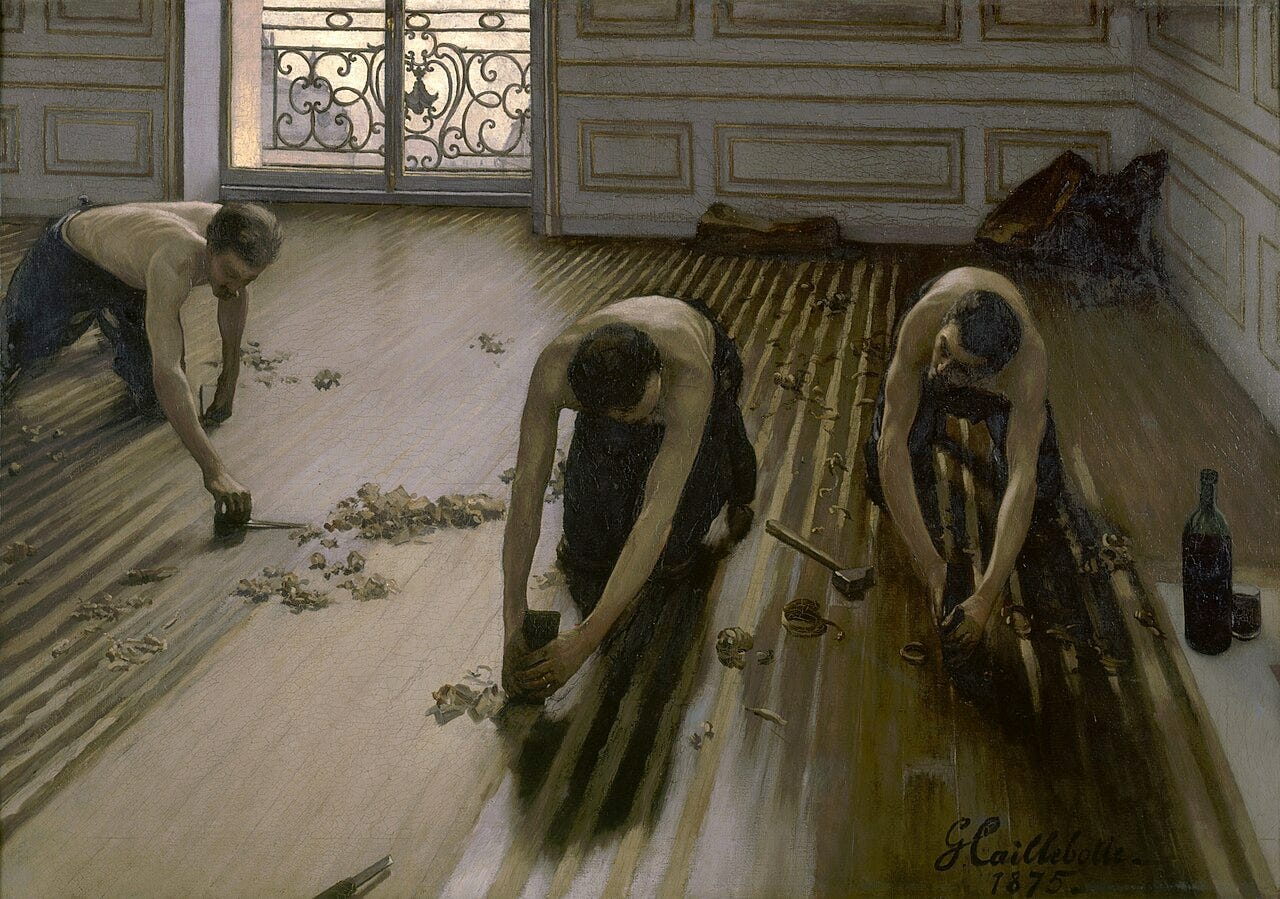
Once upon a time, in a remote kingdom — you remember it, or you’ve heard the stories — a developer could show up at three consecutive daily standups and say, with a straight face, “still moving the button.” Or “still debuggin’.” Or “still setting up the environment.”
Not designing anything. Not deciding anything. Moving the button. Or figuring out why the library that worked yesterday now throws on line 40. Reading a Stack Overflow thread from 2014 where the accepted answer is wrong and the third comment is right. Fighting the build. Guessing at an undocumented flag. Three days of this, and nobody blinked, because that was just… the job.
We’ve decided to be sad about losing that.
My take is — fuck that shit.
Sure, part of it was that the industry had normalized it. Around 2021, some software engineers lived a little like nobility — two or three hours of actual work wedged between table-football matches, Xbox sessions, and fruit Thursdays.
But that was only part of it.
So today, one camp is convinced AI is coming for software engineering — the jobs, the salaries, the whole profession. Gone. The other camp is busy insisting AI can’t actually code: Look at this hallucinated function! Look at this security hole! It’ll never really do the work! Well — AI does generate a lot of code. It also generates a lot of garbage in some cases. Both are true. But it’s the wrong argument.
We’ve quietly convinced ourselves that the interesting part of software engineering was typing. That the craft lived in the keystrokes. This prolonged grind of vertically centering the div or figuring out why the library misbehaves this time.
The interesting part was never writing the code.
It was deciding what to build and why.
It was the whiteboard sessions where the team fought two irreconcilable requirements into a truce.
It was the architecture — where the seams go, what talks to what, which decision you’ll regret in eighteen months.
It was pinning down requirements from a stakeholder who doesn’t know what they want until they see what they don’t want.
It was tying it all together: this system, that constraint, this team, that deadline, the thing that has to still be true when traffic is 10x.
That’s the work. That was always the work.
The three days lost to a misbehaving dependency? That was never the work. That was friction — an artifact of a tooling ecosystem we tolerated because we had no choice, dressed up over time as craftsmanship. We got so good at surviving the friction that we started mistaking the friction for the profession. For some, debugging the button became a personality.
Good times make for strange romances. When headcount is cheap and deadlines are soft, “I spent three days on a library quirk” is a perfectly acceptable sentence. Then the money got expensive, and it stopped being acceptable. And that’s roughly where we are.
So let the typing go. Genuinely — good riddance! If a machine can grind through the boilerplate, wire up the CRUD, chase the dependency hell, and hand me something that compiles, that is not the death of my job. That is the removal of the part of my job I never should have been romanticizing in the first place. Because everything that made software actually hard is still hard. Harder, if anything. When generating code is nearly free, the scarce skill isn’t producing it — it’s knowing what’s worth producing, how it should fit together, and whether it’ll survive contact with reality. The volume goes up; the need for judgment goes up faster. Someone still has to hold the whole system in their head and decide. That someone is an engineer. That was always what an engineer was — we just let the tooling convince us otherwise.
The doomers are mourning a profession that isn’t dying. The deniers are defending a task that deserves to. But software engineering isn’t going anywhere. At least, not for this reason, and not for now. What’s going away is the pretending — the three-day button-push, the friction-as-identity, the quiet fiction that typing was ever the point.
I’ll miss it about as much as I miss dialing a modem. The craft is still here. It just finally has to be about the craft.