

AI coding tools make developers faster. Agents can take on chunks of implementation, testing, refactoring, and migration. Cloud platforms and APIs make infrastructure easier to assemble. Heck, every other software services company is trying to turn its SDLC into an AI-powered delivery platform.
On the one hand, we are entering the age of personal software: small tools, workflows, and systems built for one person, one team, one company, or one weird local problem.
Tomasz Karwatka described reviving his contact database by extracting context from notes, PDFs, Obsidian, LinkedIn exports, phonebook data, and Gmail, then building a simple local app around it. Tyler Jewell, CEO of Akka, spent a week mostly inside Claude while rethinking how his company should operate in an AI-human workflow.
CEOs are literally building. This is not just good ol’ “everyone becomes a programmer”. It is something more interesting: more thinkers, tinkerers, and operators can turn their mental models into working tools.
And it is truly amazing.
There is another side to this story, though. On the surface, this sounds like it should make software success easier. More people can try. More startups can launch. More teams can digitize workflows previously trapped in spreadsheets and meetings.
But a lower entry barrier does not reduce competition. It increases it.
The market gets flooded with more products, more demos, more internal tools, more AI wrappers, more vertical apps, more weekend prototypes, more software houses claiming proprietary delivery platforms, and more SaaS companies repositioning themselves as agentic workflow platforms.
Alas, not everyone becomes a successful software company.
We’ve seen it before.
Social media made everyone a creator. Well, not literally everyone, but close enough to change the market. You no longer needed a studio, a publisher, a TV network, or a record label to reach people.
We called it democratization.
And it was. More people could publish. More people could be seen. More people could build an audience without asking permission.
But it did not make everyone influential.
The creator economy became a power-law market, with a high concentration of engagement among the top roughly 0.5% of creators. Millions created. A few earned. A tiny fraction dominated.
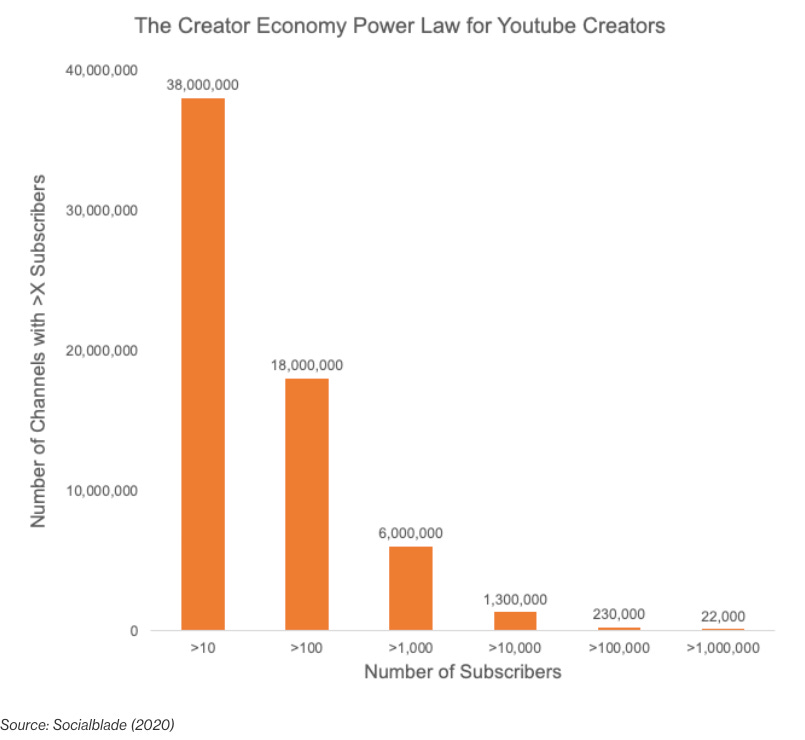
That is the lesson worth remembering.
When the barrier to entry falls, markets usually become more competitive. More participants enter. More substitutes appear. The market does not usually hand everyone higher profits. It attracts competitors until excess returns are competed away.
The gains move to whatever remains scarce.
In Taleb’s language, this is a move toward Extremistan: the domain where one observation can dominate the aggregate, and where scalable work creates extreme outcomes. A creator does not need to be 1,000 times better to get 1,000 times the attention. Distribution, compounding, and visibility do the work.
Software is not suddenly easy. That would be the wrong claim.
Production systems, security, integrations, reliability, maintenance, design, and customer understanding still matter. Good software is still hard.
But the relative cost of getting some working software is falling.
The customer is no longer comparing you only to another vendor with a large engineering team. They are comparing you to an internal tool. To a software house with an AI platform. To a feature from an incumbent. To a generated prototype. To doing nothing. To a good-enough workflow assembled by someone inside the company.
For a long time, “we can build it” was a meaningful claim. It implied access to scarce talent, process, and execution capacity.
Outside of extreme or niche cases, my bet is that “we can build it” becomes table stakes.
The harder question is: Why would the customer choose you?
I wrote before that the moat many software service companies sell is disappearing. General technical execution is becoming less scarce. The old pitch, “we can build this for you,” is losing power as AI makes building more accessible.
Obviously, that does not mean all moats disappear. It means the moat moves.
If software is cheaper to produce, customers will not pay a premium because you can produce it. They will pay because you can operate in an environment others cannot. Because you understand a niche better than generic competitors. Because you are close enough to the business to know what should be built in the first place.
They choose you because you understand the workflow. The edge cases. The politics. The handoffs. The exceptions. The stupid details that never fit into the product requirements document.
They choose you because they trust you. Because if the system breaks, someone is accountable. Because security, compliance, uptime, and support are not afterthoughts.
That is the part cheap software does not solve.
AI lowers the cost of software creation. It does not lower the cost of being chosen. In fact, if the social media parallel is any good, it elevates the cost of being chosen!
This is where many companies will get confused. They will ship more, demo more, prototype more, and generate more. They will mistake activity for advantage.
But the market does not reward software for existing. It rewards software for mattering.
The creator economy already ran this experiment. Making creation easier made attention, trust, taste, and distribution more valuable.
Software is next.
AI may make software cheaper to create. But software success was never just about creation. And it’s going to be even less so.