

Recently I bought my son a pair of Nikes. They cost around three hundred złoty ($80 or so at today’s rate). I remember buying my first pair somewhere in the mid-nineties, in primary school, and it was a big deal — I had to travel to a different city and save money for months. The funny thing is the price was about the same — three hundred, give or take. One could say that the price tag for regular Nikes pretty much froze for 30 years.
Which is weird, when you think about it, because nothing else around it froze. Polish CPI rose about fourfold between 1995 and 2025. Wages rose roughly tenfold. Polish footwear prices fell about thirty percent in nominal terms over the same period. The regular price of Nikes in 1995 might have cost roughly the equivalent of ⅓ of an average Polish salary, while in 2026 it is more like 3% — a tenfold change.
Part of it is of course a remarkable growth of the Polish economy — from a country struggling after leaving the iron curtain to the 21st largest economy in the world (by GDP numbers). The other way of looking at it is less remarkable, but still interesting — Nike brand deflation. Nike stopped being a premium brand and became regular footwear.
Shoe Dog
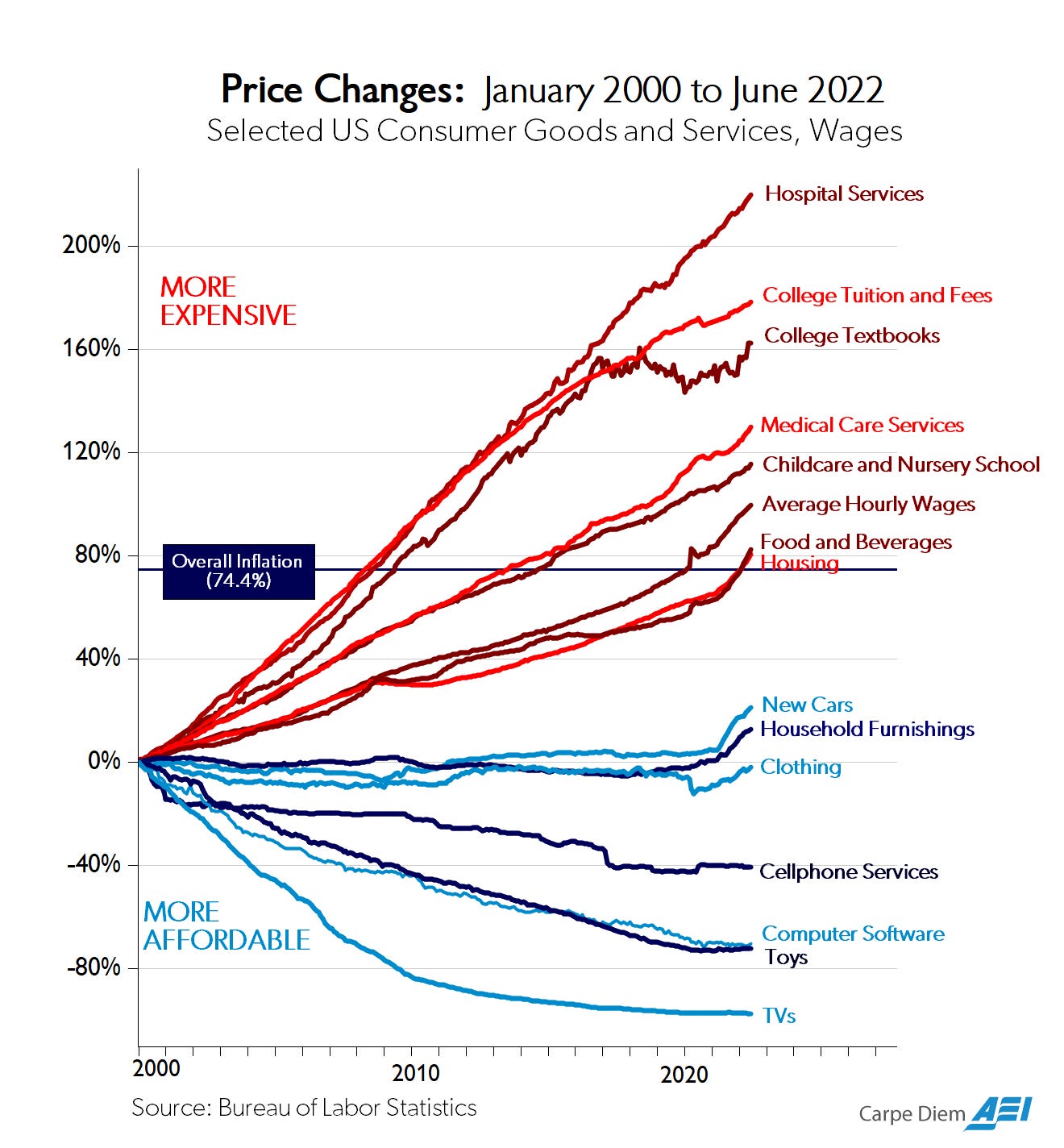
One explanation is that manufactured goods deflated everywhere relative to services: containers, trade liberalisation, Chinese capacity. US footwear prices are up about 22% since January 1996 while the overall basket more than doubled. Sneakers didn’t get cheap so much as everything else got expensive around them. You’ve probably already seen Mark Perry’s much-circulated chart elsewhere anyway, so you might know what I am talking about.
But there’s a second question underneath, and it isn’t that much about price. It’s about what a single pair still means, and who gets to keep that. Which is where Shoe Dog turns out to be useful.
Picture this: 1962, Kobe. Phil Knight walks into Onitsuka with no company at all, introduces himself as an American shoe distributor, invents the name Blue Ribbon Sports on the spot, and walks out with distribution rights for the western United States. First year: 1,300 pairs, $8,000 gross. About six dollars a pair — for a shoe someone else designed, someone else made, and someone else owned the name of.
Nike did eventually own factories briefly, in New Hampshire and Maine, and closed them at a write-off of about $10m — in a year when total profit was $15m. It hasn’t made a finished shoe since 1985. The scarcity was never in the factory — Japan had good factories, which is precisely why he went there. It was getting the shoe onto the feet of American runners whose opinion travelled, with a track coach’s design and endorsement attached.
The memoir is charming, as founder memoirs typically are, but it also carries some interesting insights into Nike’s business model. Knight built a distribution and credibility company, and rented the shoe production.
All this brings me to software.
App Store avalanche
I stumbled upon a statistic recently. New app releases on the App Store grew about 30% in 2025, to roughly 600,000. Then 560,000 arrived in the first half of 2026 alone — roughly double the prior-year half. Downloads over the same period grew 2%, to 17.6 billion. Downloads per new app roughly halved in twelve months.
The same shift shows up on the supply side. App Store publishers went from ~780k in February 2025 to ~1.1 million by August 2026, while apps per publisher fell from 2.42 to 2.33. Interestingly, it isn’t incumbents shipping more (so where exactly is AI building software for them?). It’s a lot more people shipping their first thing.
Mobile games give the cleanest read on quality: releases up 77%, games earning over $20,000 up 14%, and 96.7% of releases stuck under a thousand downloads. It got to the point where Apple began blocking Replit and Vibecode updates under Guideline 2.5.2 in March.
Marginal cost was never the point (so far…)
The tempting read is that software is repeating the sneaker story. Sneakers got cheap because the marginal cost of production fell (offshoring, containers, scale).
But cheap to make was never Nike’s problem. Nike’s problem is that owning a pair stopped meaning anything — it flooded its own icons, drifted off performance, and the premium walked. What it cost to make the shoe had nothing to do with it.
Software’s marginal cost was already zero, and had been for decades. Shapiro and Varian wrote it down in 1998: information is costly to produce and cheap to reproduce, high fixed cost and negligible marginal cost, and therefore “cost-based pricing just doesn’t work: a 10 or 20 percent markup on unit cost makes no sense when unit cost is zero”.
What AI collapsed is first-copy cost — the price of getting version one to exist at all. Building the first copy used to mean an agency and a five-figure invoice, $5,000 to $50,000 for something simple and six figures for anything real. It now means a $200 subscription and a few weekends. Two orders of magnitude off the price of existing at all.
(Side note: actually AI has an interesting effect on the marginal cost of software, as tokens spent by users are a very tangible cost; but that’s another story)
And the first-copy cost was doing two jobs. It filtered — shipping anything took enough effort that not everything got shipped. And it protected the margin, because catching up with whoever shipped first meant paying that effort all over again. Difficulty was the moat. Remove the moat, and we get 560,000 apps chasing 2% more attention.
Where the scarcity goes
It doesn’t disappear. That’s what “software is dead” gets wrong. Christensen wrote the correction two decades ago: commoditization at one layer sets off “a reciprocal process of decommoditization at the next level of value added” (yeah, it’s a mouthful). Asked directly whether profits vanish or merely change hands, he was firmly on “change hands”.
Technology rarely eliminates scarcity; it moves it somewhere else in the system.
Generic software gets cheaper, more abundant, more competitive. Producing it has stopped being a moat — the barrier to building something functional has collapsed, and writing the code buys you less every quarter. What’s left is the relationship: owning the channel, or sitting close enough to the business to know what’s worth building. Knight had both, without needing the theory. He had the shelves and he had Bowerman’s runners, and he rented the shoe from a company that only had a factory.
Except Nike eventually lost that relationship. It surrendered running to Hoka and On while sliding from performance into lifestyle (Hill’s first act as CEO was to announce he was “putting sport back at the center of everything that we’re doing” — a sentence you only say once it has moved off the centre).
Which leaves one difference between the two halves of this story.
When Nike diluted its own icons it had a lever. It could make fewer Dunks — painful, expensive, but available. Supply was something Nike controlled, so restraint was a strategy.
Nobody controls the supply of software. There is no franchise management for the App Store, no decision anyone can take to ship less (and thank God). Apple can reject slop at the gate, and does, but a gate is not a factory — and the App Store is about as tightly guarded as centralised marketplaces get. The abundance is the condition.
So the sneaker playbook — make less, charge more, restore the premium — isn’t available in software. Only the other half is: move to where the scarcity went, and get there before anyone else.
Three hundred złoty for a pair of Nikes is a bargain, and it took sixty years and a global supply chain to make it one. My guess is that generic software gets there way faster.