


I keep hearing two competing narratives — in real life, and in their extreme forms on social media.
One is: AI will eliminate software engineering (mostly hands-off CEOs, VCs, social media influencers). The other is: AI is a passing fad, and we are at the peak of the inflated expectations cycle (mostly skeptical hands-on engineers).
My bet: neither is right, and both miss the point of a technology transformation we have seen many times before.
Backdrop: Economic climate
Let’s zoom out a little.
It is sad to notice, but the 2026 tech layoff count is climbing, and we are dangerously close to being one of — if not the — worst years since the pandemic. Take that in for a moment.
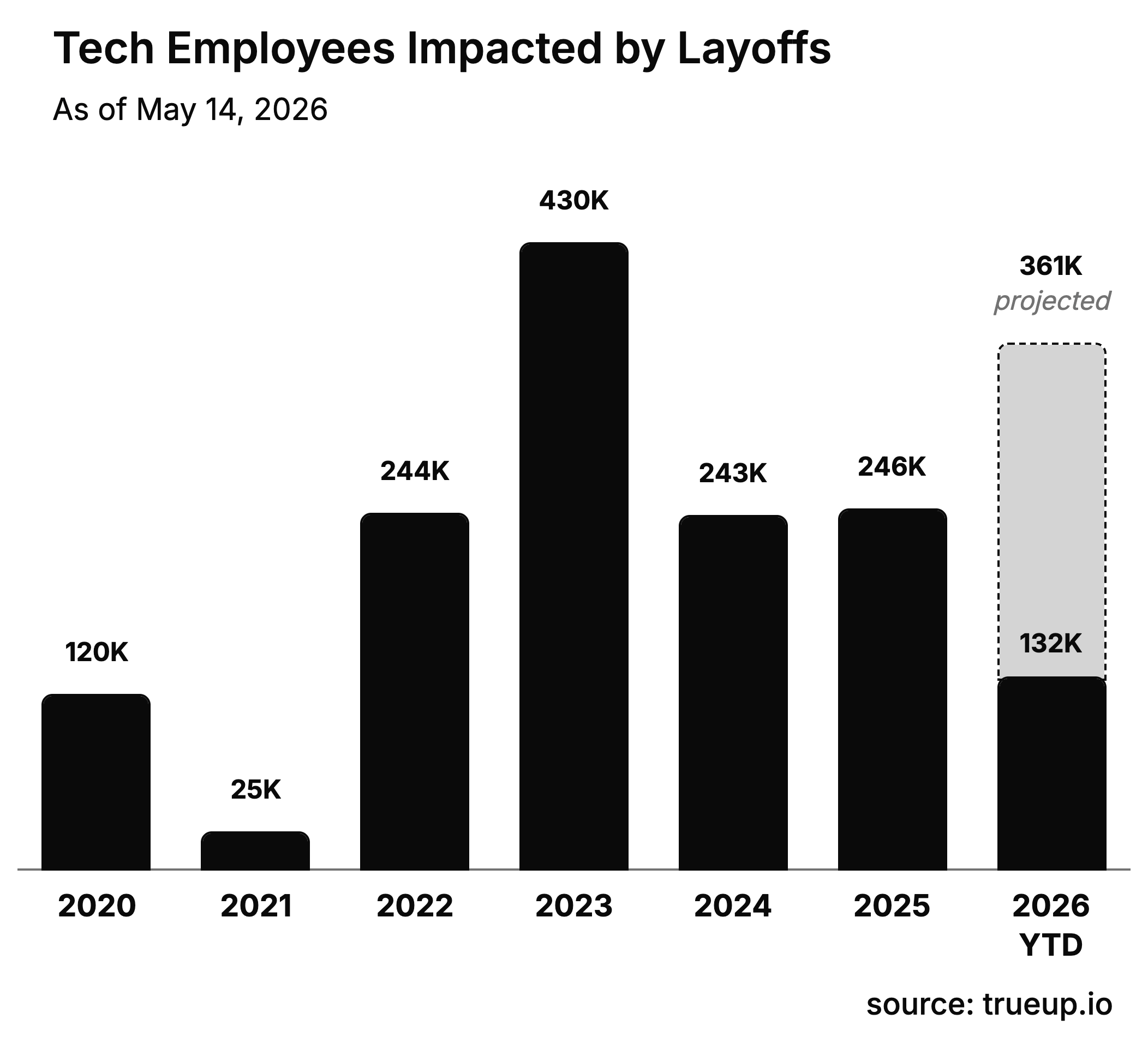
By the first week of May, the TrueUp full-year projection sits near a staggering 361,000. Trackers disagree on the exact tally (Layoffs.fyi: ~103,000; Trueup: ~132,000) because they count differently, but they agree on the shape: 2026 will pass 2025’s ~246,000 US tech layoffs, with months to spare. Kalshi and Polymarket prediction markets have it at 91–93% odds.
(Disclaimer: if you look those numbers up, they are unlikely to be exactly the same — the data flows in continuously, and even while I was writing this essay they were, sadly, increasing)
The Q1 names are unambiguous.
Oracle: ~20,000–30,000 cuts in March, tied to a $2.1B restructuring charge, explicitly funding AI data centers.
Intel: 25,000+ between 2025 and 2026, headcount now under 100,000.
Amazon: ~30,000 (and counting).
Meta: 8,000 in Q1 (Zuckerberg said the cuts were structured as headcount reduction in service of AI infrastructure) on top of a quarter where revenue grew 33% and net income grew 61%.
Cloudflare cut 20% of its workforce while growing revenue 34%.
Coinbase cut 14% in a quarter where revenue fell 31%.
PayPal: up to 20% of headcount over two to three years under a new CEO.
And yet, the coin has another side.
FRED’s Indeed Hiring Lab index for US software development job postings — IHLIDXUSTPSOFTDEVE for the curious — sits at 72.15 as of May 14, 2026. Pre-pandemic baseline is 100. So postings are still well below their 2022 peak. But they have been climbing since early 2025, and as of February US software-development postings were up 10% year-over-year while total US job postings declined 5.8%. The pattern I noted in March — that openings had been growing since the bottom of the dip in early 2025 — has continued and accelerated.
This is the article in two numbers: layoffs accelerating to a record; openings climbing back at a 10% YoY pace. Both are true at the same time.
How can that be?
The same six companies cutting headcount in Q1 had thousands of open engineering positions on their own careers pages on the same days the layoffs were announced — and a few of them are revealing. Meta: heavy on AI Research Scientists and ML Engineers. PayPal: Lead Product Manager, Agentic Commerce. Coinbase: Principal Machine Learning Engineer. Same for Cloudflare and GitLab.
Two CEOs
Two CEO statements from the last sixty days frame the whole story.
GitLab’s Bill Staples described his restructuring — three management layers removed, R&D reorganized into ~60 smaller teams — as “not an AI optimization or cost cutting exercise.” He said it in the same statement in which he also said “software will be built by machines, directed by people” and that agents will “plan, code, review, deploy and repair software.”
Wipro — yes, the Indian 200k+-employee behemoth — said the interesting bit out loud as early as 2024! When the company began cutting hundreds of mid-level onsite roles, an internal source described the doctrine as “Left-Shift”: “The work of a level 3 employee is shifted to a level 2 employee, who is given appropriate tools. A level 1 employee does the level 2 work, and the idea is that the work of a level 1 employee is automated.” That is the substitution mechanism stated cleanly. Wipro has continued — recruiters describe TCS, Infosys, and Wipro as having quietly cut around 50,000 jobs across 2025 under the label “performance management” or “skill mismatch,” while Wipro itself simultaneously hired 7,500 freshers in FY26 and now lists no fewer than 10,000 open positions (which you can check here).
The Wipro doctrine is the article. Push the work down the seniority ladder, give it tools, automate what is left at the bottom. Every other company is doing some version of it. Not everyone will say so on the record. Wipro said so two years ago.
The market is now discounting the AI-restructuring story even when CEOs deliver it cleanly. Cloudflare fell 24% on its AI announcement. PayPal fell 8%. Marc Andreessen — who has every incentive to talk AI up — called it a “silver bullet excuse.”
So what is happening?
We’ve seen this movie before
In 2008, every company of meaningful size had a Database Administrator. They patched, backed up, tuned, provisioned. By 2018, the title was rare. The popular reading: cloud killed DBAs.
The Bureau of Labor Statistics tells a different story. Database Administrators and Architects is projected to grow 4% from 2024 to 2034 (worth noting — the average growth rate across all professions is 3%), ~7,800 openings a year, median wage $104,620. Yet it would be dishonest to pretend nothing changed. You don’t meet DBAs at conferences anymore.
But that’s not even the whole story! True, AWS RDS and its peers absorbed the routine 70% of what a DBA used to do. The remaining 30% — schema design, query optimization, security posture, capacity, reliability — got more valuable, got renamed, and got absorbed into other roles. The vanilla Software Engineer got some of it on their plate, but new roles also emerged — Database Reliability Engineer, Data Platform Engineer, Data Engineer. New titles. Often paid better, by the way.
The function evolved and expanded. The vocabulary changed. But the people who refused to evolve got sorted out.
But let’s push the lens back.
The typical argument I keep hearing is: “But Pawel, cars really did kill horse-drawn carriages.”
But did they?
Yeah, it turns out they did. Between 1870 and 1900, in ten major US cities, the number of teamsters — carriage and wagon drivers — grew 328%, while the population grew only 105%. The horse-drawn era was expanding employment in the transport function right up to the moment cars arrived. Motor cabs reached London in 1897, outnumbered horse cabs by 1910, and the last horse-drawn hackney license was relinquished in 1947 — half a century of overlap. So yes — cars killed the carriages.
But…
The drivers didn’t disappear. The function — moving people and goods for a fare — exploded! Today’s combined population of taxi, rideshare, and delivery drivers dwarfs the teamster cohort of 1900.
The tool changed completely. The function persisted, and grew.
The narrative we remember is cars replaced carriages. The data says the function survived a tool transition and got much bigger.
If you ask me, those are two completely different stories.
From inside the seat
My personal experience is this. 60–70% of what an engineer used to spend their day on — boilerplate, scaffolding, glue code, test setup, first-pass documentation, routine refactors, the long tail of “Stack Overflow for an hour” tasks — is being absorbed by tooling.
Not eliminated. Absorbed.
It still gets done, in a tenth of the time, by a person plus a model. The remaining 30–40% — system design, ambiguous problem framing, integration across messy boundaries, judgment about what not to build — has become more valuable.
This is the Wipro Left-Shift in microcosm. Routine work absorbed into a managed layer. Strategic work concentrated and repriced upward. The engineers who lean into the new tooling are roughly two to three times more productive than they were in 2023. The engineers who don’t are visible from across the room. They are the people the layoff lists are quietly built around — at the same time the company is opening req after req for AI engineers, platform engineers, and AI product managers.
This is not replacement. This is sorting. The headcount may not change much. Which people fill those seats will.
Act accordingly
A workforce restructuring is in progress with multiple drivers — 2020–22 overhiring, the long-postponed cleanup of teams built in an era of free capital, the higher interest rate environment, and a genuine productivity shift from AI tooling. AI is the one clean future-facing word that wraps all of them into a single acceptable public sentence. But it is not the whole story.
The composition is what is actually shifting. Roles that were a large share of headcount in 2020 — high-volume support, low-leverage operations, manual QA, boilerplate-heavy backend, parts of middle management whose job was coordination overhead — are getting compressed. Roles that barely existed in 2020 — AI product managers, ML platform engineers, AI compliance, agent integration, AI-augmented sales engineering, prompt-driven analysts — are being hired at higher salary bands than what was cut. PayPal’s Agentic Commerce PM is not an anomaly. It is just the data point of the substitution.
So what does this all mean to you?
If you build software: the people who will not learn the new tooling will be sorted out. Not because AI replaced their job — because the job changed underneath them and they did not move with it. The DBAs who learned cloud became platform engineers and got paid more. The DBAs who did not, you stopped meeting at conferences. There is a version of this article being written in 2034 about software engineers. You can choose which side you want to be quoted on.
If you run a company: the “AI made me do it” framing has lost its credibility with the market, your employees, and increasingly the press. The honest framing — we overhired, we are right-sizing, and we are shifting the composition of the workforce toward roles that work with AI — is harder to deliver but holds up. Wipro stated the doctrine clearly in 2024 and is hiring 10,000 people while doing it.
The carriages went away. The drivers stayed, learned a new machine, and grew 10x over a century. The DBAs got renamed. The work got more valuable. The function persists. The tools change.
The people who change with the tools keep their seat.